Η ΧΩΡΑ ΤΟΥ ΠΟΥΘΕΝΑ / No Man’s Land, Chora, Kythira, September 2026
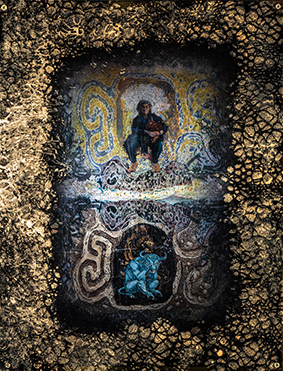
Created in 2022, the bioart installation Photophobia – later renamed Worms Altar: Make Amends – was inspired by the proposition of curator Dr Megakles Rogakos that Marcel Duchamp’s With Hidden Noise carried a concealed reference to the Theseus–Minotaur myth. It takes the labyrinth literally, as intestinal architecture, and makes visible the labour of decomposition that our culture keeps hidden.
This self-portrait continues that inquiry. The Minotaur, confined at the centre of the maze, does not fight his victims. He dissolves what enters and assimilates it. He is not violence. He is digestion, decay, and the return of matter – the invisible stages of the Cycle of Life we were taught to fear and then taught not to look at.
The composition is a dipole. The two registers mirror each other across a bright horizon. In the upper chamber I sit holding a live rooster – an image taken from my painting Πετεινοκρατούσα / Holding my Rooster. The pose is deliberate: my bare feet enlarged and planted on the ground rather than lifted above it. She is myself at my real age and in my real body – the self I could inhabit under exactly the same constraints, if the Minotaur were finally accepted and the spell lifted. In the lower chamber, in light blue, the animal self waits, ashamed, where it was put.
Between them runs the surface that separates a thing from its reflection.
The border is a network of earthy tones that reflections sometimes turn golden. It is also, if you look at it long enough, mycelium: the underground web through which everything is taken apart and handed on.
I Accept
The manifesto introduced with Holding My Rooster.
- I Accept all aspects of existence – not only the spiritual, the Good, Beautiful and Perfect, but also the earthly, the animal and the worn.
- I Recognise that bodily functions, secretions, leftovers and organic waste are not shameful but essential to the cycle of life.
- I Extend My Love beyond humanity – to animals, plants, biodiversity, soil, water, and the planet itself.
- I Embrace Both Roles – the gentle caretaker and the respectful hunter – acknowledging that to sustain life I must also take it.
- I Honour both halves of the cycle: Inception, Birth, Growth and Prime; and Decline, Death, Decomposition and Diffusion, which feeds Regeneration.
Decarnis: the culturally transmitted shame of the mortal, decomposing, permeable body. Incarnis: its reversal – sacred embodiment, the flesh received back. From the Venus Incarnis series.
Η εγκατάσταση bioart «Φωτοφοβία», που δημιουργήθηκε το 2022 και μετονομάστηκε αργότερα σε «Βωμός Σκουληκιών: Επανορθώστε», εμπνεύστηκε από την πρόταση του επιμελητή Δρ. Μεγακλή Ρογκάκου ότι το With Hidden Noise του Μαρσέλ Ντυσάν έκρυβε μια αναφορά στον μύθο του Θησέα και του Μινώταυρου. Παίρνει τον λαβύρινθο κυριολεκτικά, ως εντερική αρχιτεκτονική, και κάνει ορατό το έργο της αποσύνθεσης που ο πολιτισμός μας κρατά κρυμμένο.
Η παρούσα αυτοπροσωπογραφία συνεχίζει την ίδια αναζήτηση. Ο Μινώταυρος, έγκλειστος στο κέντρο του λαβύρινθου, δεν παλεύει με τα θύματά του. Διαλύει ό,τι μπαίνει μέσα του και το αφομοιώνει. Όχι σαν προσωποποίηση της βίας, αλλά της πέψης – τα αόρατα στάδια του Κύκλου της Ζωής που μάθαμε να φοβόμαστε και ύστερα να μην κοιτάμε. Κι όλοι κρύβουμε ένα Μινώταυρο στην κοιλία μας.
Η σύνθεση αποτελείται από δύο επίπεδα που καθρεφτίζονται εκατέρωθεν ενός φωτεινού ορίζοντα. Στον επάνω θάλαμο κάθομαι κρατώντας έναν ζωντανό πετεινό. Πήρα αυτήν την εικόνα από τον πίνακά μου «Πετεινοκρατούσα / Holding my Rooster». Η στάση είναι εσκεμμένη: τα γυμνά μου πόδια, μεγεθυμένα, πατούν στο χώμα αντί να υψώνονται πάνω από αυτό. Είναι ο εαυτός μου στην πραγματική μου ηλικία και στο πραγματικό μου σώμα. Είναι ο ιδεατός εαυτός που θα μπορούσα να κατοικήσω μέσα στους ίδιους ακριβώς περιορισμούς, αν ο Μινώταυρος γινόταν επιτέλους αποδεκτός και λύνονταν τα μάγια. Στον κάτω θάλαμο, σε απαλό μπλε, περιμένει ντροπιασμένος ο ζωικός εαυτός, εκεί όπου τον έβαλαν.
Ο άξονας συμμετρίας ανάμεσά τους χωρίζει ένα πράγμα από το είδωλό του.
Το πλαίσιο στο πλεξιγκλάς είναι ένα δίκτυο από γήινους τόνους που οι αντανακλάσεις άλλοτε κάνουν χρυσούς. Κι αν το κοιτάξεις αρκετή ώρα, μοιάζει με μυκήλιο: τον υπόγειο ιστό που βοηθά να αποδομηθεί η οργανική ύλη και επιστρέψει στη Φύση.
Αποδέχομαι
Το μανιφέστο που παρουσιάστηκε με το έργο «Κρατώντας τον Πετεινό μου».
- Αποδέχομαι όλες τις πλευρές της ύπαρξης – όχι μόνο την πνευματική, το Καλό, το Ωραίο και το Τέλειο, αλλά και τη γήινη, τη ζωική και τη φθαρμένη.
- Αναγνωρίζω ότι οι λειτουργίες του σώματος, οι εκκρίσεις, τα υπολείμματα και τα οργανικά απόβλητα δεν είναι ντροπή, αλλά ουσιώδη για τον κύκλο της ζωής.
- Επεκτείνω την αγάπη μου πέρα από την ανθρωπότητα – στα ζώα, τα φυτά, τη βιοποικιλότητα, το χώμα, το νερό και τον ίδιο τον πλανήτη.
- Ασπάζομαι και τους δύο ρόλους – του Φροντιστή και του Κυνηγού με σεβασμό – αναγνωρίζοντας ότι για να συντηρήσω τη ζωή πρέπει και να την αφαιρέσω.
- Τιμώ και τα δύο μισά του κύκλου: Σύλληψη, Γέννηση, Ανάπτυξη και Ακμή· και Παρακμή, Θάνατο, Αποσύνθεση και Διάχυση, που τροφοδοτεί την Αναγέννηση.
Decarnis: η πολιτισμικά μεταδιδόμενη ντροπή για το θνητό, αποσυντιθέμενο, διαπερατό σώμα. Incarnis: η αντιστροφή της – ιερή ενσάρκωση, η σάρκα που ξαναγίνεται δεκτή. Από τη σειρά Venus Incarnis.

